
Textiles are rarely perceived as a driving force of civilization. We are used to seeing fabrics simply as materials for clothing, household items, and stylish details. Yet almost no one, except perhaps a narrow circle of specialists, considers fabric as an engine of historical processes.
However, in different eras, materials and the technologies used to produce them became the cause of economic growth, international trade, colonial expansion, and even wars. The history of humanity is, in many ways, woven from threads of cotton, silk, wool, and linen.
Silk. The Fabric That Connected Continents
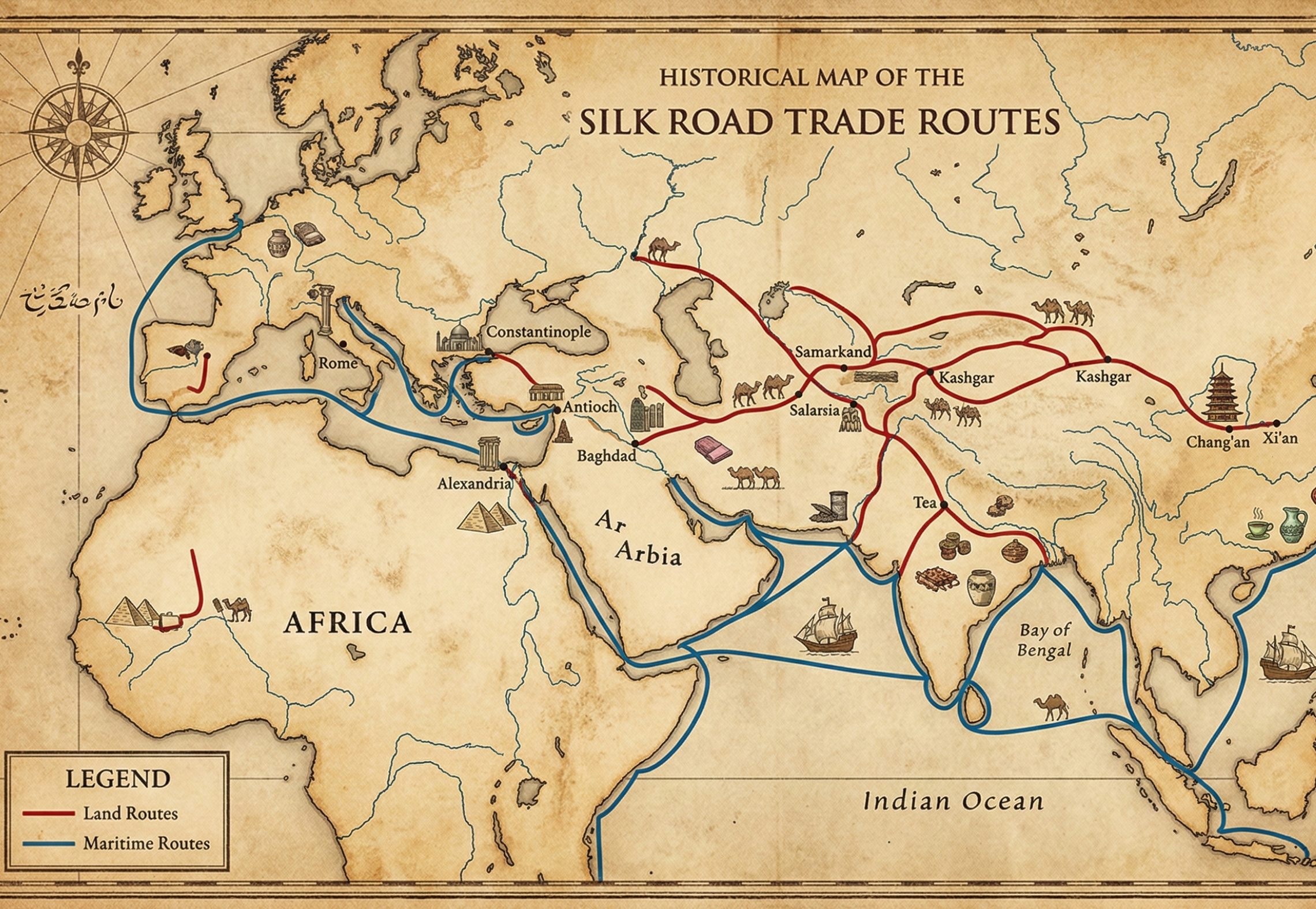 Silk was one of the first textiles to influence global processes. In Ancient China, the technology of silk production was strictly guarded, and attempts to reveal its secrets were punishable by death. The high value of silk turned it into a symbol of power and status.
It was the demand for this material that gave its name to the Great Silk Road. Trade routes connected East Asia with Europe, facilitating not only the exchange of goods but also ideas, religions, and technologies. Silk became a catalyst for cultural integration and economic development across entire regions.
Cotton. The Fabric That Transformed the Global Economy
.png) Cotton played a key role in shaping global industry. With the development of mechanical spinning machines in the eighteenth century, cotton production became the foundation of the Industrial Revolution in England.
Cotton played a key role in shaping global industry. With the development of mechanical spinning machines in the eighteenth century, cotton production became the foundation of the Industrial Revolution in England.
The growing demand for cotton influenced global trade and became one of the factors supporting the slave system in the United States. Cotton plantations shaped the economies of entire states, while textile factories defined the character of new industrial cities in Europe.
Thus, a soft and accessible fabric found itself at the center of global political and social processes.
Wool. The Foundation of Medieval Wealth
In the Middle Ages, the wool trade brought enormous income to European states. England, for example, built much of its economy around the export of raw wool and finished woolen cloth. Taxes on wool trade financed urban development and strengthened royal authority.
Guilds controlled the quality and volume of wool production, forming early elements of economic regulation. Textile became not just a commodity, but an instrument of state policy.
Linen. A Universal Material of Civilization
Linen was one of the first cultivated fibers. It was used in Ancient Egypt, Rome, and across Eastern Europe. Linen fabrics served for clothing, sails, sacks, and ropes.
Linen made possible the great maritime voyages of the Age of Discovery. Without durable sails and ropes made from plant fibers, it is impossible to imagine the development of navigation and the exploration of new territories.
Denim. A Symbol of the Industrial Era
Denim was originally created as a durable work fabric. Jeans were designed for miners and laborers. Over time, however, they became a cultural symbol of freedom, youth movements, and globalization.
In the second half of the twentieth century, jeans became universal clothing for millions of people around the world. Denim blurred the boundaries between classes and cultures, becoming part of mass identity.
Synthetic Fibers. A Technological Turning Point
.png) The emergence of nylon, polyester, and other synthetic materials in the twentieth century marked a true revolution. These fabrics transformed military industry, sports, medicine, and everyday fashion.
The emergence of nylon, polyester, and other synthetic materials in the twentieth century marked a true revolution. These fabrics transformed military industry, sports, medicine, and everyday fashion.
Parachutes, strong ropes, protective clothing, membrane materials for extreme conditions – all became possible thanks to the development of the chemical industry. Textile moved beyond its original functions and evolved into a high-tech tool.
Textile as a Driver of Change
Each of these fabrics reflects a particular stage in human development. Some materials stimulated international trade, others became sources of social conflict, and still others ensured technological progress.
Textile did not merely accompany history. It actively shaped it. Economic flows, political interests, and cultural transformations passed through fabrics.
Today, in the era of innovative fibers and sustainable production, textile continues to influence society. Perhaps the new materials of the future will transform the world just as significantly as silk, cotton, or wool once did.
The history of humanity is not only a chronicle of wars and discoveries. It is also the story of threads from which civilization was literally woven.
Modern analogues of wool were discussed in the previous blog.